Japanese Guest Houses
 
Japanese Inns
Experience the Beauty, Cuisine, and Art of Japan by Staying at a Traditional Japanese Inn (or Ryokan) Our Free Personalized Service Makes It Easy.
Japanese Minshuku
Guest Support at Japanese Guest Houses

Ryokan Search by Japanese Prefecture
Ryokan Search by Japanese Onsen

Learn about Japanes Ryokans
Ryokan Styles
Japan Travel Suggestions
Japan Travel Informative Booklet by Japanese Guest Houses
Professional Japanes Tour Guides

About Japanese Guest Houses Ryokan Reservation Service
Rediscover Japan Terms and Conditions
Japanese Guest Houses - Home
Info for Ryokan and Minshuku

Japanese Ryokans
Japan Tours
Japanese Guest Houses
Also Try Japan Roads
for Tours to Experience Japan's Cultural Diversity

Japanese Guest Houses

Facebook
Twitter
Flickr
Japanese Guest Houses Blog
 

Japan Rail Passes - Book Online
Travel Guard  Insurance

USA and Canadian
Residences Only

Japan Travel Blog Japan Endless Discovery - JNTO

Discover Japanese Hospitality at a Ryokan
 Home > About Ryokans > Japanese "Kaiseki" (traditional, multi-course dinner)

Courtesy of AD&MD, Paris, France

Japanese "Kaiseki" (traditional formal dinner)

**Announcement: Japanese Guest Houses has a new "sister site" - Japan Roads - for people who are interested in doing a tour of Japan. For more information, click here.

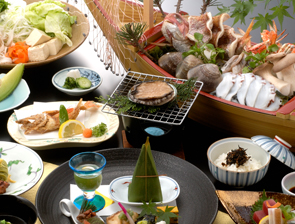
At a Japanese ryokan, one of the highlights is dining on "kaiseki" (a traditional, multi-course dinner). Indeed, many Japanese think of a ryokan as a place to dine on "kaiseki" rather than as a type of accommodation. One Kyoto ryokan owner told me that over 70% of his income was from his diners while the rest came from overnight guests. What exactly is kaiseki? The term "kaiseki" means hot stone in a kimono fold, and it is believed that Zen priests would tuck hot stones wrapped in towels next to their stomach to cure their hunger pangs during their morning and afternoon prayers (the term "kai" means a fold in a kimono and "seki" means stone). In this way it was believed that only a small amount of kaiseki would be enough to take away your hunger. Originally, kaiseki was a simple, vegetarian meal served during the traditional tea ceremony. It was thought the tea would taste better if the guests were not so hungry. Today kaiseki is no longer a strictly vegetarian meal but may also include both meat and fish. Courtesy of TW, Tuscon, Arizona, USA

One kaiseki dinner can consist of anywhere from 6 to 15 different kinds of food. For example:
"shiizakana" (appetizers served with Japanese sake)
"mukouzuke" (sashimi - slices of raw fish)
"kuchitori" (a small side dish)
"suimono" (a soup)
"nimono" (simmered vegetables)
"aemono" (food dressed with sauce)
"kounomono" (Japanese pickles)
"hassun" (food from the mountains and the sea)
"sunomono" (food marinated in  vinegar)
"yakimono" (grilled fish)
"mushimono" (steamed food)
"nabemono" (Japanese hot pot)
rice
miso soup
dessert
The kind of food served will change according to the different months, seasons and what is freshly available at the local market. It is also depends on the area. For example, a kaiseki served in February in Kyushu would be different than a kaiseki served February in northern Honshu.

Courtesy of J-PD, Geneva, SwitzerlandIt is said that kaiseki is a meal at one with nature. In fact, guests will often find such things from nature as flowers and leaves adorning the food. The ingredients are natural, of high quality and chosen according to the season. Most important of all, the ingredients are all freshly served. (Please note: this is why it is so important guests check in on time at a ryokan. Check-in time is before 17:30 (5:30) so the chefs have time to properly prepare the kaiseki meal. However, if guests check in late then the kaiseki is ruined since the ingredients are no longer fresh). Throughout the meal, each course is served immediately after it is prepared so as to maintain the freshness of the ingredients. The design and the display of the food is a  reflection of shapes found within nature. For example, the food represents such things as forests, mountains, islands, flowers, and leaves. The food and the tableware also contrast in color, texture, flavor, consistency, and shape just as in nature.

The kaiseki menu changes throughout the year, and the cycle of change begins in November when the year's first tea is ready for grinding. This year is divided into 12 months, and both the food and the tableware reflect the changing months and seasons.Courtesy of WS, Epping, NSW, Australia

Sources:
MontrealFood.com
About-Japanese Cuisine
The World in a Bowl of Tea
NetNihon-Japanese Food


Other Useful Ryokan Information

If you have never stayed at a ryokan, then Planning Your Stay at a Japanese Ryokan will help you better plan your stay.

Our Ryokan Styles page will tell you about the various types of ryokans available

If it is your first time staying at a ryokan, you may want to read our page on Ryokan Customs

Here is some more detailed information about Staying at a Ryokan including ryokan cuisine

For more information about dining on Japanese "kaiseki," please see Japanese "Kaiseki" (traditional, multi-course dinner)

In A Ryokan Experience, a guest describes his stay at a ryokan on Miyajima Island

Read Interviews with Three Kyoto Ryokan Owners and their experiences hosting foreign guests

A step-by-step explanation of how to put on a Japanese "yukata" (robe)

Here is a description about the dos and don'ts of Japanese Bathing Etiquette, and here is how to use a Japanese-style toilet

How big is a tatami mat room? Go to this Tatami Mat Conversion Table and find out.

Read David Paget's article "Japanese Buddhist Temple Overnight" and a guest's article " A Night on Mount Koya" about their experiences staying overnight at Buddhist Temples on Mount Koya in Wakayama Prefecture.

Read guest's Comments about their ryokan stays

Links to Experience Japan
Top

Part of the Rediscover Group of Travel Companies
Rediscover Japan Co., Ltd. (Japanese Guest Houses)
Hyogo-ken Chijitoroku Ryokogyo 3-609 (Hyogo Prefecture Travel Agent License Number 3-609)
10-5-401-1-(2) Sakae-machi, Kawanishi-shi, Hyogo-ken 666-0033 Japan
Phone: 072-756-6242 answered in English during normal office hours of 9:00am to 5:00pm Japan Standard Time
Staff at Japanese Guest Houses - Links - Affiliate Program
Copyright © 2000-2013 Rediscover Japan Co., Ltd. All Rights Reserved.Privacy Policy